






A SOC (Security Operations Center) analyst monitors an organisation's IT infrastructure for cyber threats, investigates security alerts, and responds to incidents before they escalate into breaches.
SOC analysts work inside a dedicated security operations team - watching logs, analysing network traffic, and stopping attacks in real time, 24 hours a day.
The role is the frontline of enterprise cybersecurity. Every company that takes security seriously runs a SOC - and every SOC needs trained analysts at every tier.
| Tier | Role Title | Primary Responsibility | Tools Used |
|---|---|---|---|
| L1 - Triage Analyst | Alert Monitoring Analyst | Monitor dashboards, triage incoming alerts, close false positives, escalate confirmed threats to L2 | IBM QRadar, EDR, NIDS/NIPS |
| L2 - Incident Analyst | Security Incident Responder | Investigate confirmed threats, trace attack paths, contain and remediate incidents | SIEM, Wireshark, CyberChef, Sysinternals |
| L3 - Threat Hunter | Senior SOC Analyst / Threat Hunter | Proactively hunt threats before alerts fire, develop and tune detection rules, lead incident response | MITRE ATT&CK, custom scripts, forensics tools |
A NOC (Network Operations Center) manages network uptime and performance - it fixes connectivity problems, monitors bandwidth, and resolves outages.
A SOC (Security Operations Center) manages security - it detects cyber threats, investigates incidents, and stops attacks.
Both operate 24/7 in shift environments. But the skills, tools, and career paths are entirely different. If your goal is cybersecurity, SOC is the correct track. NOC experience can be a useful foundation, but the two roles do not overlap in day-to-day work.
According to NASSCOM's 2024 cybersecurity workforce report, India faces a shortfall of over 1 million trained cybersecurity professionals. Organisations across banking, insurance, IT services, and government are actively hiring SOC analysts at every level - and entry-level L1 roles are the highest-volume positions they recruit for.
Hyderabad ranks among the top three cities in India for active SOC hiring. Cloud4C, Wipro, TCS Security, HCL Technologies, and Mindtree all run SOC operations here. New L1 analyst positions open every month in the city - and the skills these companies screen for are exactly what this course teaches.
IBM QRadar is the preferred SIEM platform in Indian enterprise and government SOC environments. Knowing QRadar specifically - not just SIEM theory - is the difference between a resume that gets shortlisted and one that doesn't. AimNxt is one of the few institutes offering structured IBM QRadar training as the core SIEM tool, not an afterthought.
Learn SOC analysis, threat detection, and incident response from a hands-on cybersecurity professional with 10+ years of real-world experience in Security Operations, SIEM monitoring, and threat intelligence the same skills companies hire for at ₹4-12 LPA roles.

10+ years of experience in real-time security monitoring, log analysis, and incident response across enterprise networks, cloud environments, and endpoints. Trained 500+ students from beginner to job-ready SOC Analysts.
Expert-level experience in tools like Splunk, IBM QRadar, ArcSight, ELK Stack, Wireshark, and Sentinel. Learn how to analyze logs, detect threats, and respond to incidents using industry-standard tools in live lab environments.
Curriculum designed to match globally recognized industry standards and current SOC job requirements. Each module is structured to help you build practical skills in security monitoring, threat detection, and incident response aligned with real-world roles and responsibilities of a SOC Analyst.
Beyond technical skills, our trainer provides resume guidance, mock SOC analyst interviews, and LinkedIn/GitHub portfolio mentoring - so you don’t just learn security concepts, you get hired as a SOC Analyst.
Most institutes offering soc analyst training in Hyderabad teach L1 skills only. L1 means alert monitoring and basic triage - necessary, but limited. AimNxt trains you for L1 and L2 in a single program.
You graduate with investigation and incident response skills, not just monitoring ability. That qualification applies to a significantly broader range of job postings.
| Program Detail | What You Get |
|---|---|
| Duration | 3 months (12 weeks) |
| Placement | Job Interview Guarantee Program |
| Primary SIEM Tool | IBM QRadar – Analyst, Admin and Engineer levels |
| Roles Covered | SOC L1 (Triage Analyst) + SOC L2 (Incident Analyst) |
| Batch Size | 15–20 students maximum – no large batches |
| Training Modes | Classroom (KPHB) + Online Live Sessions (Hybrid) |
| Lab Access | Hands-on labs throughout – not just end-of-course |
| LMS Access | 1 Year Access to recorded sessions and course materials |
The curriculum is structured across three phases - from IT and security fundamentals to advanced SOC operations. Every module maps to tasks in real SOC job descriptions.
Phase 1 - Foundations
Operating systems
Threat actors
CIA triad
Attack surfaces
Encryption standards
Certificates
PKI - required for log analysis
TCP/IP, DNS
HTTP/HTTPS
Routing
Switching
Firewall basics
SQL injection
XSS
Broken authentication - from a defender's view
Phase 2 - SOC Core Skills
Malware
Ransomware
Phishing
Insider threats
APTs
Tier 1 triage workflow
Tier 2 investigation
Tier 3 threat hunting methodology
Event IDs
Login events
Process creation
Registry changes
Firewall
IDS/IPS
Proxy
VPN log interpretation
Alert triage
Endpoint forensics
Isolation procedures
Defence-in-depth
Layered security
Patch management
Architecture
Log source management
Offenses
Correlation rules
Syslog
Auth.log
Process monitoring
Suspicious commands
Network intrusion detection and prevention - Snort and Suricata basics
Data Loss Prevention concepts
Identity and Access Management
Phase 3 - Advanced SOC Operations
Full phishing analysis workflow - headers
URLs
Payloads
All 14 ATT&CK tactics
Real-world attack scenario mapping
Hypothesis-driven
Detection rule development
Hunting playbooks
CyberChef
Sysinternals Suite
IOC lookup tools (VirusTotal, AbuseIPDB)
Safe analysis lab
Indicators of compromise
Indicators of attack
Threat feeds
Every learner who successfully completes the training program at AimNxt receives an official Course Completion Certificate. Our certificate validates your practical skills, hands-on project experience, and industry-ready knowledge, making your resume stand out during interviews.
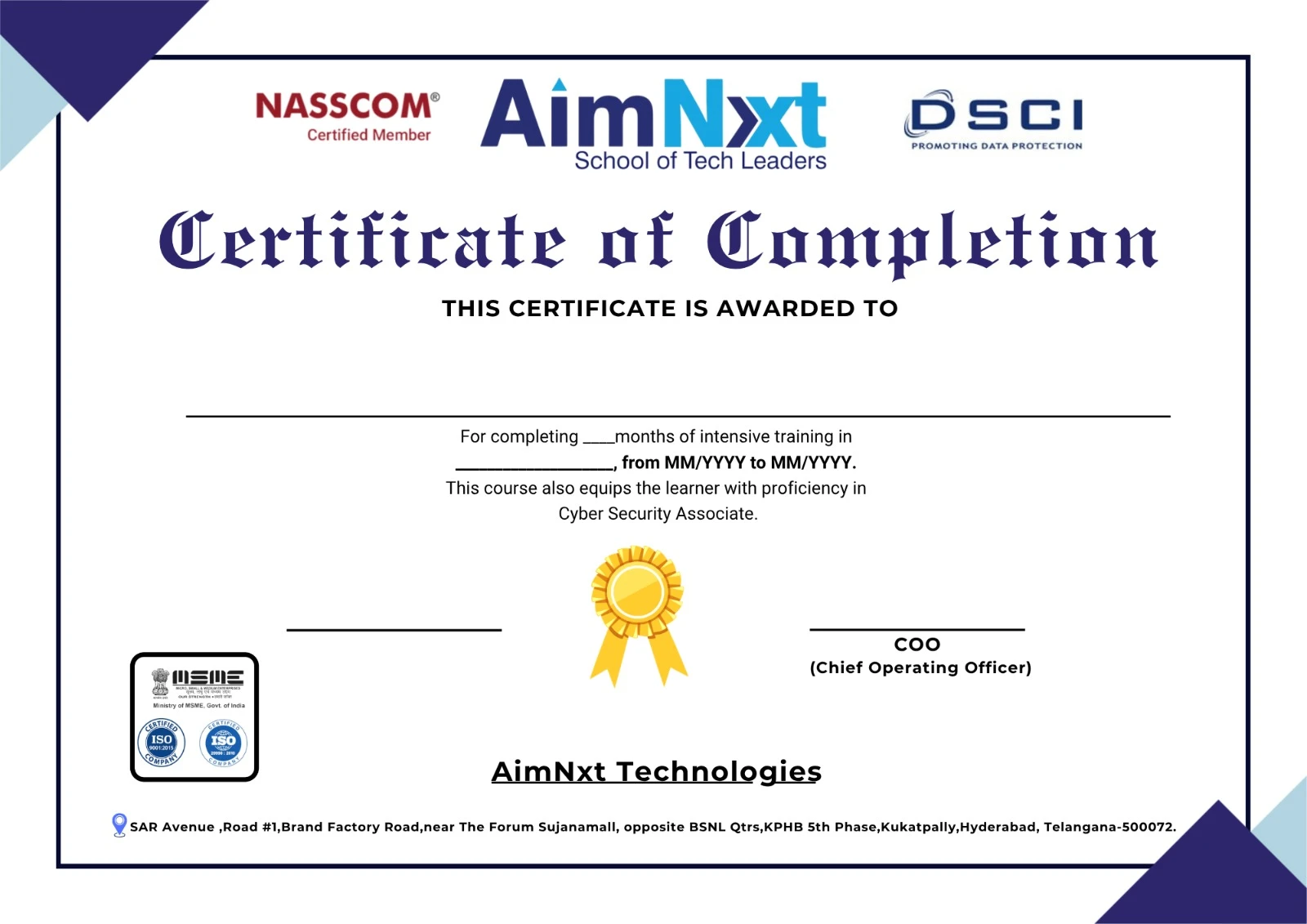
Complete our SOC Analyst L1 & L2 Training Program and become job-ready for enterprise Security Operations Centres (SOC). Gain practical expertise in Networking, Cybersecurity Fundamentals, Threat Detection, Malware Analysis, SIEM, EDR, Splunk, Wireshark, Nmap, Incident Response, MITRE ATT&CK, Cyber Kill Chain, and Log Analysis through real-world attack simulations and live SOC labs.
MITRE ATT&CK is a globally recognised matrix of tactics and techniques used by real attackers - from initial access and persistence through lateral movement to data exfiltration. It is now a standard reference in every enterprise SOC. L2 and L3 roles require you to map incidents against ATT&CK to understand what the attacker did and what they might do next.
The Cyber Kill Chain framework teaches you to trace an attack from the first reconnaissance step through to final exfiltration - so you can identify exactly where a breach started and contain it before it progresses.
These two frameworks are tested in technical interviews at Cloud4C, Wipro Security, and government cybersecurity units. Most SOC training programs in Hyderabad either skip them or mention them without practical application. AimNxt covers all 14 MITRE ATT&CK tactics with real-world scenario mapping in lab sessions.
Phishing emails are the entry point for more than 90% of corporate cyberattacks, according to the 2024 Verizon Data Breach Investigations Report. Despite this, most SOC training programs in Hyderabad do not include email analysis as a dedicated module. AimNxt covers full phishing analysis - email headers, link extraction, payload identification, and indicator extraction - because this is a daily L1 task in every enterprise SOC.
The malware analysis module uses CyberChef and Microsoft Sysinternals Suite to examine suspicious files safely - without executing malware in a live system. You will learn both static analysis (examining the file without running it) and dynamic analysis (running it in an isolated environment and observing behaviour). These skills directly address the types of tickets that escalate from L1 to L2 desks every day.
You will work with 12 tools across the 3-month program - from foundational analysis tools to enterprise-grade SIEM. Below is the full tool set with the context in which each is used.
Alert investigation, rule tuning, and log source configuration
Capture and analyse network packets for incident investigation
Identify weaknesses and support SOC alert triage
Decode and analyse email payloads, encoded malware strings
Process monitoring, autoruns, malware behaviour analysis on Windows
Write and test intrusion detection rules, understand signature-based detection
Security Orchestration, Automation and Response - L2 and L3 context
Endpoint alert triage, isolation workflows, agent-based detection
Extended detection and response - cross-layer visibility for senior SOC roles
Open-source intelligence gathering for threat hunting and IOC research
Log reading, rule interpretation - foundational for all SOC log analysis work
SIEM training in most programs covers only the analyst level - reading dashboards and investigating offenses. AimNxt covers all three operational levels because SOC job descriptions increasingly expect candidates to understand the full platform, not just the analyst interface.
| QRadar Level | What You Learn | Career Relevance |
|---|---|---|
| Analyst Level | Build dashboards, investigate flagged offenses, create incident reports, manage alert queues | Required for all SOC L1 and L2 roles |
| Admin Level | Manage log sources, configure offense rules, maintain asset profiles, user management | Required for L2+ roles at enterprise SOCs |
| Engineer Level | Design data collection pipelines, tune SIEM detection rules, integrate new log sources | Differentiates you at technical interviews |
This course is built for freshers first. You do not need prior cybersecurity experience or a background in security to start. If you have a B.Tech, BCA, MCA, or BSc in Computer Science, Information Technology, or a related field - you can begin from Module 1.
| Profile | How This Course Fits |
|---|---|
| Fresh B.Tech / BCA / MCA / BSc graduate | Start from Module 1. No prior security knowledge needed. Role: SOC L1 job target on completion. |
| IT professional switching to cybersecurity | Existing networking or development knowledge accelerates Phase 1 and 2 modules significantly. |
| CCNA-certified candidate | Strong networking foundation. Advance faster through Phase 1. Target L2 roles on completion. |
| Working professional (weekday or weekend batch available) | Weekend and evening batch options. Backup classes for missed sessions. Hybrid mode available. |
| Non-IT graduate with IT interest | Assessed on a case-by-case basis. Contact AimNxt for a pre-enrollment counselling session. |
Find answers to common questions about our SOC Analyst Training in Hyderabad, certification, and career opportunities.
Build industry-ready skills with practical, job-oriented training programs in Networking, Cyber Security, Generative AI, Full Stack Development (Java & Python). Gain hands-on experience, work on real-world projects, master in-demand technologies, and prepare yourself for successful career opportunities in the IT industry.

· Laptop Mandatory · Participation Certificate · Hands-on Practical Learning