






Learn from a seasoned security leader with extensive experience in cybersecurity, defense, and critical infrastructure protection.

20+ years in cybersecurity, defense, and critical infrastructure protection with CISSP, CISM, CEH, and ISO 27001 LA certifications.
Former Indian Navy Commander with extensive operational leadership experience and discipline-focused approach to security.
IIM Calcutta alumnus with deep knowledge of security governance, risk frameworks, and enterprise security architecture.
Currently leads Enterprise & Public Sector Security at LTTS (T-Fiber Project), bringing real-world insights to the classroom.
This course is designed for security professionals with experience in the cyber security domain. Check if you meet the eligibility criteria.
If you have 6 years of full-time experience in two or more of the 8 CISSP domains, you are eligible to take the CISSP exam.
Our course comprehensively covers all 8 domains of the CISSP exam, mapped to real-world cybersecurity challenges faced by modern enterprises.
Understand and Apply Security Concepts
Security Boundaries
Evaluate and Apply Security Governance Principles
Manage the Security Function
Security Policy, Standards, Procedures, and Guidelines
Personnel Security Policies and Procedures.
Understand and Apply Risk Management Concepts.
Social Engineering.
Establish and Maintain a Security Awareness, Education, and Training Program
Asset classification, ownership, protection, handling, retention.
Planning for Business Continuity.
Project Scope and Planning.
Business Impact Analysis.
Continuity Planning.
Plan Approval and Implementation.
Categories of Laws.
Laws.
State Privacy Laws.
Compliance.
Contracting and Procurement.
Identifying and Classifying Information and Assets.
Establishing Information and Asset Handling Requirements.
Data Protection Methods.
Understanding Data Roles.
Using Security Baselines.
Cryptographic Foundations.
Modern Cryptography.
Symmetric Cryptography.
Cryptographic Life Cycle.
Asymmetric Cryptography.
Hash Functions.
Digital Signatures.
Public Key Infrastructure.
Asymmetric Key Management.
Secure Design Principles.
Techniques for Ensuring CIA.
Understand the Fundamental Concepts of Security Models.
Select Controls Based on Systems Security Requirements.
Understand Security Capabilities of Information Systems.
Shared Responsibility.
Data Localization and Data Sovereignty.
Assess and Mitigate the Vulnerabilities of Security.
Architectures, Designs, and Solution Elements.
Client-Based Systems.
Apply Security Principles to Site and Facility Design.
Implement Site and Facility Security Controls.
Implement and Manage Physical Security.
OSI Model.
TCP/IP Model.
Analyzing Network Traffic.
Common Application Layer Protocols.
Transport Layer Protocols.
Protocol Security Mechanisms.
Secure Voice Communications.
Remote Access Security Management.
Multimedia Collaboration.
Monitoring and Management.
Controlling Access to Assets.
The AAA Model.
Implementing Identity Management.
Managing the Identity and Access Provisioning Life Cycle.
Comparing Access Control Models.
Implementing Authentication Systems.
Zero-Trust Access Policy Enforcement.
Understanding Access Control Attacks.
Building a Security Assessment and Testing Program.
Performing Vulnerability Assessments.
Implementing Security Management Processes and Collecting Security Process Data.
Apply Foundational Security Operations Concepts.
Address Personnel Safety and Security.
Provision Information and Assets Securely.
Apply Resource Protection.
Managed Services in the Cloud.
Conducting Incident Management.
Implementing Detection and Preventive Measures.
Logging and Monitoring.
Automating Incident Response.
The Nature of Disaster.
Understand System Resilience, High Availability, and Fault Tolerance.
Recovery Strategy.
Recovery Plan Development.
Training, Awareness, and Documentation. Organizational policies, roles, and responsibilities.
Investigations.
Major Categories of Computer Crime.
Ethics.
Designing secure systems and infrastructure.
Introducing Systems Development Controls.
Establishing Databases and Data Warehousing.
Storage Threats.
Understanding Knowledge-Based Systems.
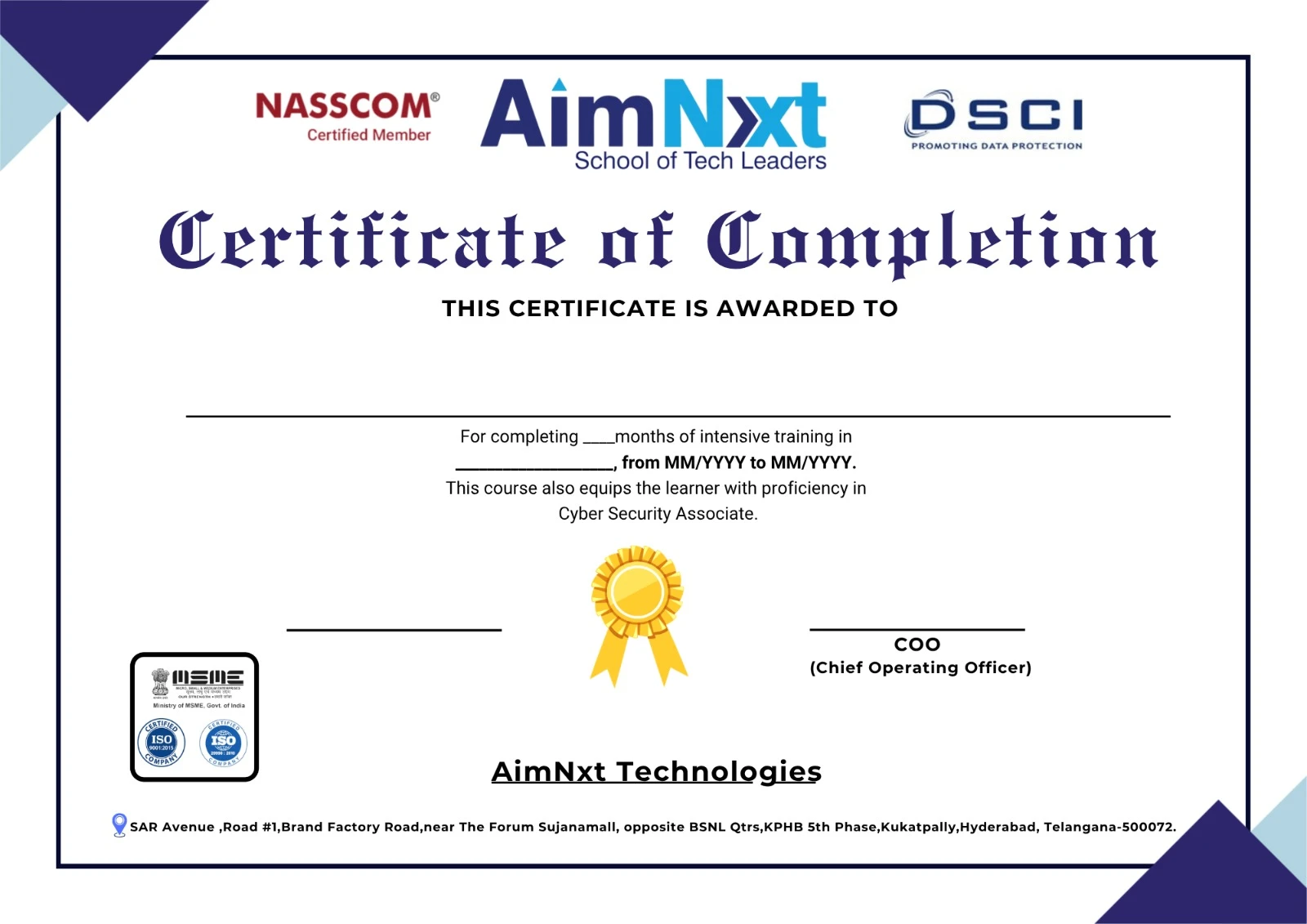
Every learner who successfully completes the training program at AimNxt receives an official Course Completion Certificate. Our certificate validates your practical skills, hands-on project experience, and industry-ready knowledge, making your resume stand out during interviews.
Complete our CISSP Certification Training and become qualified for senior cybersecurity leadership roles. Master Security Governance, Risk Management, Security Architecture, Cryptography, Cloud Security, Identity & Access Management, Network Security, Incident Response, Security Operations, Compliance, Disaster Recovery, and Software Development Security through the globally recognized CISSP framework.
Find answers to common questions about our CISSP training program, certification, and career opportunities.
Build industry-ready skills with practical, job-oriented training programs in Networking, Cyber Security, Generative AI, Full Stack Development (Java & Python). Gain hands-on experience, work on real-world projects, master in-demand technologies, and prepare yourself for successful career opportunities in the IT industry.